
The Eternal Birth
On the birth of God in the soul by Meister Eckhart, 13th c. Christian Mystic

A quiet mind is one which nothing weighs on, nothing worries, which, free from ties and from all self-seeking, is wholly merged into the will of God and dead to its own. Meister Eckhart.
In his time Meister Eckhart, born Johannes Eckhart in Gotha, Turingia, Germany around 1260, was a controversial figure. He was a Catholic priest, theologian, philosopher and mystic. The controversy surrounds 28 propositions suspected of being heretical. He died in prison in 1328 before any conclusive judgment was made. Of the 28 listed heretical statements, some were only ’suspected’ of heresy. Eckhart claimed he was innocent of the charges, but that he would recant anything deemed heretical with Orthodox teachings. In spite of this Pope John XXII issued a bull (In agro dominico), 27 March 1329, in which a series of statements from Eckhart are characterized as heretical, another as suspected of heresy. The Pope’s unusual decision to issue the bull after Eckhart’s death while still imprisoned was probably due to various political concerns and issues in Avignon at the time.
Eckhart was deeply influenced by Neoplatonism, and subscribed fully to Trinitarian teachings in line with Thomas Aquinas. Attempts to rehabilitate Eckhart over the centuries have only been partially successful. The Dominican Order, to which Eckhart belonged, pressed hard in the last decade of the 20th century for his full rehabilitation and confirmation of his theological orthodoxy. Pope John Paul II spoke in favour of this initiative, and often quoted from Eckhart’s teachings. It was only revealed in 2010 that the Dominican Order had received a formal response from the Vatican in 1992 which was summarized by them in this way: We tried to have the censure lifted on Eckhart ...and were told that there was really no need since he had never been condemned by name, just some propositions which he was supposed to have held, and so we are perfectly free to say that he is a good and orthodox theologian.
In recent times he has been widely adopted by what are termed ‘New Age’ teachers. There are problems both with outright condemnation historically as well as with New Age adoption by the Nones - Spiritual Not Religious demographic. Discernment is needed to engage with teachings in a way that will be deeply beneficial to the practitioner and above all to his/her community as a whole, to avoid the pitfalls of solipsistic ‘self-creation’ in isolation or separation.
Many have argued since that the teaching of a Christian Gnosis (not to be confused with Gnosticism) that Eckhart imparted was thought by the Church authorities to be potentially misleading to those unable to grasp, or ‘realize’, the subtle understanding which constitutes the highest form of knowing that he points to as unknowing. Others argue that the Church feared that the direct unknowing, in which one participates in the divine, threatened to undermine their authority.
It becomes clear, in some of the questions put to him in the Christmas sermon he gave, which I am going to publish here as a Christmas message, and which he answers very carefully, how it is possible for some to grasp ‘the wrong end of the stick’ as they say. In our own time we find many examples of this with teachers who similarly attempt to convey nondual teachings in one or another tradition, with participants more often than not only able to grasp it intellectually, and not intuitively with the spiritual senses, resulting in ‘spiritual bypassing’ and other issues. This is a complex topic I will not attempt to fully elucidate here, but rather will leave the reader/listener (an audio accompanies the text below) to absorb in their own embodied way what is being conveyed.
I stress embodied, for a propositional or purely conceptual understanding will not suffice. The words have to be meditated upon, and contemplated in the light of one’s own experience. And it goes without saying that these deep truths need to be part of a community’s conversation and mutually reciprocal self-correction, with at least a competent and ethically minded teacher for guidance. Otherwise solitary attempts to understand this can often lead to various delusions about oneself.
I have referred more than once to this important figure in the Christian esoteric tradition in the essays published on this substack. I referred to Meister Eckhart also in the penultimate chapter of my book, The Island, A Mirror for the Soul, which considers the work of Keiji Nishitani of the Kyoto School, who regarded Meister Eckhart as one of the most important teachers of the West.
While some may see the revived interest in Eckhart’s teachings as no more than another retrieved pre-modern item in the commodified global supermarket of New Age products, that reaction only arises due to the ‘wrong end of the stick’ problem I alluded to above. Anyone is only as good as what they bring to any text sacred or otherwise: if the interest is sincere, and the practice based on a longterm commitment towards transformation, not a search for ‘quick fixes’, then only the final outcome of a life lived and enacted in the light of truth, beauty and goodness matters. The proof is in the living and the relationships nurtured through this engagement.
In Kenya among various Christian communities there seems an abiding suspicion of this more esoteric side of Christianity, which constitutes a strong tradition outside the institutional exoteric forms most people are familiar with. There is a too common misapprehension that conflates ‘mystical’ with ‘heretical’. ‘Heretical’ is not an absolute, and contingent upon prevailing historical biases or political conflicts within power structures. Truth on the other hand resonates with what is eternal. In some sense this is a historical problem, and has been exacerbated since the Reformation and in our own time by the Cartesian bifurcation, followed by the Kantian framework of modernity that has determined our picture of the world in such a way that such teachings can even appear nonsensical to uninstructed, and unpracticed, minds. As I have said on many occasions we live now under a tyranny of propositional knowledge, without the counterbalancing and primary experiential modes of procedural, perspectival and participatory knowing that were well understood by the ancient world.
If anyone has any comments they wish to offer on this, after reading/listening to Meister Eckhart’s Christmas sermon, I would really appreciate you offer them openly in the comments box below the essay, so that a healthy conversation can maybe unfold that might help towards elucidating the difficulties concerning such teachings in our time, so that they are not wrongly categorised as ‘New Age’.
What is undeniable in our time is that pluralism can no longer be dismissed. There is a deep need to engage in serious discourse that is not limited to the conceptual or doctrinal expressions across faiths and belief systems. As the great philosopher and Catholic Raimon Panikkar said:
We need to become more and more aware that humanity is one, and that no one has the monopoly on ultimacy or on truth… We are - all of us - the legitimate heirs of the sum total of human wisdom.
We need to break through the conceptual divisions to reciprocally engage with the space of ‘betweeness’ through the sharing of sacred texts from the deep heart of all the great sapiential traditions, which may be the only way that will enable us to regenerate living communities of wisdom and compassion amidst the disintegrating cultural, political and economic structures of our time.
Without more ado here is Meister Eckhart’s Christmas Sermon on the Eternal Birth. I hope you will find it engaging or even inspiring and may you all have a blessed and peaceful holiday and a new year filled with abundance.
SERMON TWO
UBI EST QUI NATUS EST REX JUDAEORUM ? (Matthew 2 : 2 )
“Where is he who is born king of the Jews ?” Now observe, as regards this birth, where it takes place: “Where is he who is born ?” Now I say, as I have often said before, that this eternal birth occurs in the soul precisely as it does in eternity, no more and no less, for it is one birth, and this birth occurs in the essence and ground of the soul.
Now certain questions arise. First of all, since God is in all things as intelligence, and is more truly in them than they are in themselves, and more naturally, and since wherever God is there He must work, knowing Himself and speaking His Word - in what special respects, then, is the soul better fitted for this divine operation than are other rational creatures in which God also is? Pay attention to the explanation.
God is in all things as being, as activity, as power. But He is fecund in the soul alone, for though every creature is a vestige of God, the soul is the natural image of God. This image must be adorned and perfected in this birth. No creature but the soul alone is receptive to this act, this birth. Indeed, such perfection as enters the soul, whether it be divine undivided light, grace, or bliss, must enter the soul through this birth, and in no other way. Just await this birth within you, and you shall experience all good and all comfort, all happiness, all being and all truth. If you miss it, you will miss all good and blessedness.
Whatever comes to you in that will bring you pure being and stability; but whatever you seek or cleave to apart from this will perish take it how you will and where you will, all will perish. This alone gives being - all else perishes. But in this birth you will share in the divine influx and all its gifts. This cannot be received by creatures in which God’s image is not found, for the soul’s image appertains especially to this eternal birth, which happens truly and especially in the soul, being begotten of the Father in the soul’s ground and innermost recesses, into which no image ever shone or soul peeped.
The second question is, Since this work of birth occurs in the essence and ground of the soul, then it happens just as much in a sinner as in a saint, so what grace or good is there in it for me? For the ground of nature is the same in both - in fact even those in hell retain their nobility of nature eternally.
Now note the answer. It is a property of this birth that it always comes with fresh light. It always brings a great light to the soul, for it is the nature of good to diffuse itself wherever it is. In this birth God streams into the soul in such abundance of light, so flooding the essence and ground of the soul that it runs over and floods into the powers and into the outward person. Thus, it befell Paul when on his journey God touched him with His light and spoke to him: a reflection of the light shone outwardly, so that his companions saw it surrounding Paul like the blessed (in heaven.) The superfluity of light in the ground of the soul wells over into the body which is filled with radiance. No sinner can receive this light, nor is he worthy to, being full of sin and wickedness, which is called ‘darkness.’ Therefore it says, “The darkness shall neither receive nor comprehend the light” (John 1 : 5 ).
That is because the paths by which the light would enter are choked and obstructed with guile and darkness: for light and darkness cannot co-exist, or Gods and creatures; if God shall enter, the creatures must simultaneously go out. A person is fully aware of this light. Directly they turn to God, a light begins to gleam and glow 2 within them, giving them to understand what to do and what to leave undone, with much true guidance in regard to things of which before they knew or understood nothing.
‘Where do you know this from, and in what way?’ Just pay attention. Your heart is often moved and turned away from the world. How could that be but by this illumination? It is so charming and delightful that you become weary of all things that are not God or God’s. It draws you to God and you become aware of many a prompting to do good, though ignorant of whence it comes.
This inward inclination is in no way due to creatures or their bidding, for what creatures direct or effect always comes from without. But by this work it is only the ground (of the soul) that is stirred, and the freer you keep yourself the more light, truth, and discernment you will find. Thus no one went astray for any other reason than that they first departed from this and then sought too much to cling to outward things. St. Augustine says there are many who sought light and truth, but only outside where it was not to be found. Finally they go out so far that they never get back, or find their way in again. Thus they have not found the truth, for truth is within, in the ground, and not without.
So one who would see light to discern all truth, let them watch and become aware of this birth within, in the ground. Then all their powers will be illuminated, and the outer person as well. For as soon as God inwardly stirs the ground with truth, its light darts into their powers, and that person knows at times more than anyone could teach him. As the prophet says, “I have gained greater understanding than all who ever taught me.”3 You see then, because this light cannot shine or lighten in sinners, that is why this birth cannot possibly occur in them. This birth cannot coexist with the darkness of sin, even though it takes place, not in the powers, but in the essence and ground of the soul.
The question arises, Since God the Father gave birth only in the essence and ground of the soul and not in the powers, what concern is it of theirs? How do they help just by being idle and taking a rest? What is the use, since this birth does not take place in the powers?
A good question. Listen well to the explanation.
Every creature works toward some end. The end is always the first in intention but the last in execution. Thus too, God in all His works has a most blessed end in view, namely, Himself: to bring the soul and all her powers into that end. For this, all God’s works are wrought, for this the Father bears His Son in the soul, so that all the powers of the soul shall come to this. He lies in wait for all that the soul contains, bidding all to this feast at His court. But the soul is scattered among her powers and dissipated in the action of each: the power of sight in the eye, the power of hearing in the ear, the power of tasting in the tongue - thus her ability to work inwardly is enfeebled, for a scattered power is imperfect. So, for her inward work to be effective, she must call in all her powers and gather them together from the diversity of things to a single inward activity. St. Augustine says the soul is rather where she loves than where she gives life to the body.
To this end, then, assemble all your powers, all your senses, your entire mind and memory; direct them into the ground where your treasure lies buried. But if this is to happen, realize that you must drop all other works - you must come to an unknowing, if you would find it.
The question arises, Would it not be more valuable for each power to keep to its own task, none hindering the others in their work, nor God in His? Might there not be in me a manner of creaturely knowing that is not a hindrance, just as God knows all things without hindrance, and so too the blessed in heaven?5
That is a good question.
Note the explanation. The blessed see God in a single image, and in that image, they discern all things. God too sees Himself thus, perceiving all things in Himself. He need not turn from one thing to another, as we do. Suppose in this life we always had a mirror before us, in which we saw all things at a glance and recognized them in a single image, then neither action nor knowledge would be any hindrance to us. But we have to turn from one thing to another, and so we can only attend to one thing at the expense of another. For the soul is so firmly attached to the powers that she has to flow with them wherever they flow, because in every task they perform the soul must be present and attentive, or they could not work at all. If she is dissipated by attending to outward acts, this is bound to weaken her inward work.
For at this birth God needs and must have a vacant free and unencumbered soul, containing nothing but Himself alone, and which looks to nothing and nobody but Him. As to this, Christ says, “Whoever loves anything but me, whoever loves father and mother or many other things is not worthy of me. I did not come upon earth to bring peace but a sword, to cut away all things, to part you from sister, brother, mother, child, and friend that in truth are your foes“ (Matt.1 0 : 34 -36; d. 1 9 : 28 ) .
For whatever is familiar to you is your foe. If your eye wanted to see all things, and your ear to hear all things and your heart to remember all things, then indeed your soul would be dissipated in all these things.
Accordingly a master says, ‘To achieve an interior act, a person must collect all their powers as if into a corner of their soul where, hiding away from all images and forms, they can get to work.’ Here, they must come to a forgetting and an unknowing. There must be a stillness and a silence for this Word to make itself heard. We cannot serve this Word better than in stillness and in silence: there we can hear it, and there too we will understand it aright - in the unknowing. To him who knows nothing it appears and reveals itself.
Another question arises. You might say, ‘Sir, you place all our salvation in ignorance. That sounds like a lack. God made man to know, as the prophet says, “Lord, make them know!” (Tob. 1 3 : 4) Where there is ignorance there is a lack, something is missing, a man is brutish, an ape, a fool, and remains so as long as he is ignorant.’
Yes, but here we must come to a transformed knowledge, and this unknowing must not come from ignorance, but rather from knowing we must get to this unknowing.6 Then we shall become knowing with divine knowing, and our unknowing will be ennobled and adorned with supernatural knowing. And through holding ourselves passive in this, we are more perfect than if we were active.
That is why one master declares that the sense of hearing is nobler than that of sight, for we learn more wisdom by hearing than by seeing, and in it live the more wisely.
For the act of hearing the eternal Word is within me, but the act of seeing goes forth from me: in hearing, I am passive, but in seeing I am active.
But our bliss lies not in our activity, but in being receptive to God. For just as God is more excellent than creatures, by so much is God’s work more excellent than mine. It was from His immeasurable love that God set our happiness in suffering,7 for we undergo more than we act, and receive incomparably more than we give; and each gift that we receive prepares us to receive yet another gift, indeed a greater one, and every divine gift further increases our receptivity and the desire to receive something yet higher and greater.
Therefore, some teachers say that it is in this respect the soul is commensurate with God. For just as God is boundless in giving, so too the soul is boundless in receiving or conceiving. And just as God is omnipotent to act, so too the soul is no less profound to suffer; and thus she is transformed with God and in God.8 God must act and the soul must suffer, He must know and love Himself in her; she must know with His knowledge and love with His love, and thus she is far more with what is His than with her own, and so too her bliss is more dependent on His action than on her own.
The pupils of St. Dionysius asked him why Timothy surpassed them all in perfection. Dionysius replied, ‘Timothy is a God-suffering man. Whoever is expert at this could outstrip all men.’ In this way your unknowing is not a lack but your chief perfection, and your suffering your highest activity.
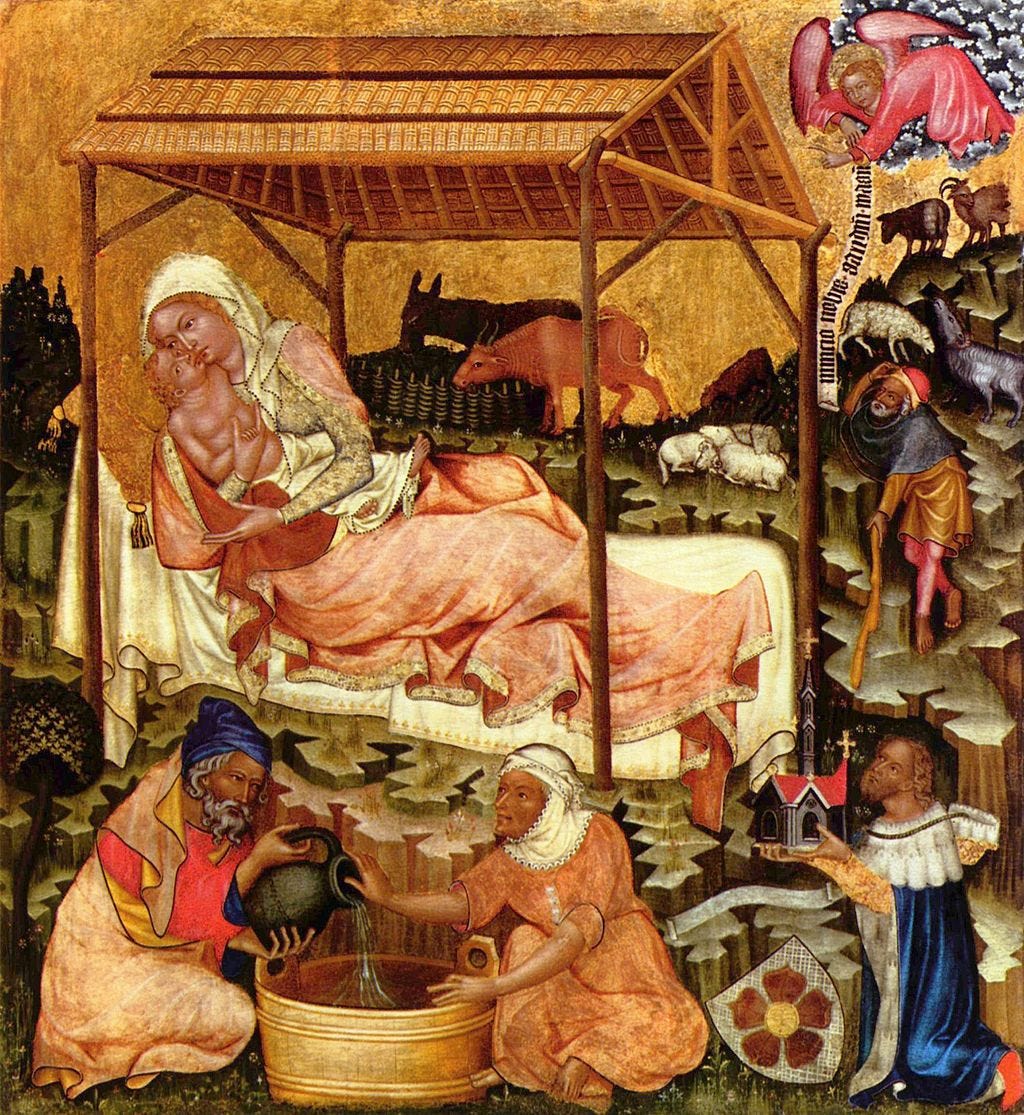
And so in this way you must cast aside all your deeds and silence your faculties, if you really wish to experience this birth in you. If you would find the newborn king, you must outstrip and abandon all else that you may find. That we may outstrip and cast behind us all things unpleasing to the newborn king, may He help us who became a human child in order that we might become the children of God.
Text (with some minor edits for length) from The Complete Mystical Works of Meister Eckhart translated and edited by Maurice Walshe, Volume 1 ©copyright 1979 M. O.’C. Walshe. First published in the U.K. in 1979 by Watkins Publishing.
Notes
1 . Cf. Sermon 1 , note 9.
2. Cf. Sermon 1 , notes 1 4 and 1 5 .
3. Cf. Eccles. 1 : 1 6 (Q).
4. Archimedes, who is said to have been killed by a Roman soldier while making geometrical drawings in the dust in his own garden at Syracuse ( 2 1 2 B.C.E.).
5 . I.e., those in heaven, not the ‘saints,’ as Miss Evans translates.
6. This is, as Quint points out, the same as the Docta ignorantia of Nicholas Cusanus (1401-64).
7. MHG Iiden means both ‘suffering’ and ‘passivity.’
8. In gote (dative), not, as Miss Evans translates, ‘into God.’